The Unexpected Correlation Between Semi Sentiment and Crypto Mining Demand
Semiconductors and cryptocurrencies might seem like inhabitants of different worlds: one, a physical industry of fabs, wafers, and equipment; the other, a digital realm of tokens, blockchains, and speculative cycles. Yet over the past decade, an unexpected correlation has emerged between sentiment in the semiconductor sector and demand from crypto mining. When miners are euphoric and building out capacity, semi sentiment often improves;
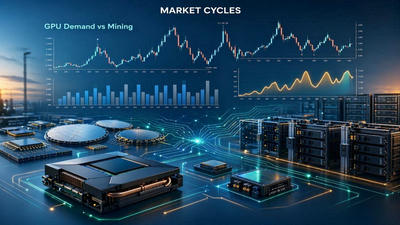
This article explores how crypto mining has influenced semiconductor demand, why semi sector sentiment often moves in tandem with mining cycles, what makes this correlation “unexpected” yet persistent, and how stakeholders can interpret it without overstating its importance.
How crypto mining connects to semiconductor demand
Crypto mining demand translates into semiconductor demand via hardware. Miners need specialized systems—GPUs, ASICs, memory, power electronics—to perform hashing and validation tasks. When crypto prices rise and mining economics become favorable, operators expand fleets, buy more cards and rigs, and invest in data‑center‑like infrastructure.
Initially, GPUs were the dominant hardware for many proof‑of‑work chains. Surges in mining often meant rapid sell‑outs of high‑end graphics cards, which had been designed primarily for gaming and professional visualization. As mining difficulty increased and competition intensified, ASICs and dedicated accelerators entered the scene for specific algorithms, tying crypto demand even more directly to specialized silicon.
Beyond compute devices, mining systems consume large volumes of supporting semiconductors: power management ICs, voltage regulators, controllers, networking chips, and memory. A large mining wave can therefore ripple across multiple segments of the semi industry, not just the headline GPU suppliers.
From hardware orders to sector sentiment
Semiconductor sentiment encompasses expectations about demand, pricing, margins, and investment cycles across the industry. Crypto mining demand factors into that sentiment primarily through two channels: visible spikes in certain product categories, and narrative amplification in markets and media.
When miners bid aggressively for GPUs or ASICs, suppliers report strong bookings and tight supply. Lead times extend, channel inventory shrinks, and pricing power improves. For companies tied to those categories, this translates into upbeat guidance, margin expansion, and positive commentary on demand outlook. Investors and analysts often extrapolate that optimism into broader semi sentiment.
At the same time, crypto‑related demand surges attract media attention. Stories about sold‑out cards, miners competing with gamers for hardware, and record profits in specialized chip segments help shape perceptions that “semi is booming.” Even if mining‑linked demand is only a fraction of total volume, its visibility can disproportionately influence sentiment.
In downturns, the reverse happens. When crypto prices fall and mining becomes less profitable, hardware purchases slow or reverse. Inventory builds up, prices soften, and companies exposed to mining see weaker results. Negative commentary around “overhang” from crypto hardware or demand normalization contributes to more cautious semi sentiment.
Why the correlation is unexpected—but intuitive in hindsight
The correlation between semi sentiment and crypto mining demand is unexpected in part because the semi industry is vast and diversified. Memory, automotive chips, industrial controllers, mobile processors, power devices, and analog ICs all dwarf pure mining‑related volumes in many periods. One might assume that crypto demand would be a niche factor with limited impact on overall sentiment.
However, mining demand often concentrates in high‑profile, high‑margin products—high‑end GPUs, specialized accelerators, and related system components. These are the segments that attract investor attention and move headlines. When a mining wave drives a significant portion of incremental demand in those categories, it can influence how the entire sector is perceived.
Moreover, crypto cycles tend to be sharp. Price run‑ups and crashes occur over short periods, creating pronounced swings in hardware orders. Semiconductor sentiment responds quickly to visible changes in bookings and pricing. Even if the underlying fundamentals in autos or industrial remain stable, sudden shocks in prominent compute segments can color overall sentiment.
In hindsight, the correlation is intuitive: a volatile, speculative activity that relies heavily on specialized hardware will naturally create demand spikes and troughs that show up in semi order books—and investor psychology often reacts more to those visible turns than to slower‑moving structural trends.
Mechanics of the sentiment link: cycles and feedback loops

Several mechanics create feedback loops between crypto mining demand and semiconductor sentiment.
1. Shortages and perceived scarcity. In mining upswings, hardware shortages emerge. Retailers and distributors report limited availability of high‑end cards; prices rise above list in secondary markets. Perceived scarcity feeds into broader narratives of “chip shortages,” even if the root cause is localized to specific products. This perceived scarcity boosts sentiment about semi pricing power and profitability.
2. Inventory swings and corrections. When mining demand fades, excess hardware appears. Companies that built inventory or capacity for mining‑linked products face corrections, discounting, or write‑downs. Reports of “excess GPU inventory” or “ASIC demand collapse” dampen sentiment, raising concerns about overcapacity or margin pressure in related segments.
3. Capex and roadmap decisions. Semi companies adjust roadmaps and capex in response to mining demand. The launch timing of new GPUs, the allocation of wafers to specific die configurations, or the design of future accelerators can be influenced by expectations of crypto‑linked demand. When those expectations prove too optimistic or pessimistic, investor sentiment reacts to perceived missteps.
4. Narrative framing. Market participants love simple stories. “Crypto boom drives GPU demand” or “Crypto bust leaves semi overexposed” are easy narratives to latch onto. Even when reality is more complex, these narratives can shape sentiment and trading behavior, reinforcing the correlation.
These feedback loops mean that crypto mining is not just a demand source; it is also a sentiment amplifier in semi markets.
Limitations of the correlation: where it breaks down
The semi–crypto sentiment correlation, while real, has clear limitations. It does not determine the entire sector’s trajectory, and it can be overshadowed by other forces.
First, many large semi segments are only indirectly affected by mining. Automotive, industrial, consumer, and mobile chips follow their own cycles, tied to macroeconomic conditions, regulatory changes, technology transitions, and product launches. A mining boom or bust may barely touch demand for an automotive MCU or an industrial sensor.
Second, over time, mining hardware has shifted from general‑purpose GPUs to more specialized ASICs for certain chains. That specialization narrows the set of companies and products affected by mining cycles. Semi sentiment that focuses only on broad‑based players may therefore reflect a muted correlation compared with earlier GPU‑dominated phases.
Third, structural drivers such as AI, cloud, and edge computing have grown in importance. Demand for accelerators and high‑bandwidth memory increasingly comes from AI training and inference workloads, which can dwarf mining in both volume and strategic significance. As AI becomes the primary narrative in compute semis, crypto mining’s influence on sentiment may become more episodic.
Finally, market participants have learned from past cycles. Some analysts now explicitly adjust their models to separate mining‑related sales from underlying demand, tempering sentiment swings when crypto cycles turn.
Recognizing these limitations helps avoid overstating the correlation or misattributing broader sector moves solely to mining dynamics.
Energy, regulation, and the sentiment equation

Crypto mining’s dependence on energy and its regulatory profile also feed into semi sentiment. High‑energy workloads require robust power electronics, cooling systems, and system‑level design, tying mining demand to power semiconductors and infrastructure‑related chips.
When regulators crack down on energy‑intensive mining—through restrictions, taxation, or outright bans—demand for mining hardware in affected regions can drop quickly. Semi companies exposed to those regions or categories may revise guidance downward, influencing sentiment. Conversely, migration of mining activity to regions with cheaper energy or more favorable policies can create new demand pockets, lifting sentiment selectively.
Discussions about sustainability and energy efficiency also play a role. As criticism of mining’s energy footprint rises, sentiment may shift toward semi products that enable more efficient compute or alternative consensus mechanisms. Companies that position themselves as providers of “greener” high‑performance compute may benefit even if traditional mining hardware demand wanes.
In this sense, the sentiment correlation is shaped not just by crypto prices, but by evolving attitudes toward energy, regulation, and the societal impact of mining.
Implications for semi companies: managing exposure and messaging
For semiconductor companies, the semi–crypto sentiment correlation presents both opportunities and management challenges.
On the opportunity side, mining booms can drive incremental revenue and utilization for high‑end products. Firms can monetize existing designs, sell into new customer segments, and achieve economies of scale that benefit other markets. Careful pricing and allocation strategies—balancing miners, gamers, and professional customers—can extract value while maintaining broader relationships.
On the challenge side, heavy perceived exposure to mining can make a company’s sentiment and valuation more volatile. Management teams must communicate clearly about how much of demand is mining‑related, how sustainable that demand is, and how they plan to navigate inevitable cycles. Overreliance on mining can raise questions about risk management and strategic focus.
Many companies have responded by segmenting their narratives: they highlight structural drivers like AI, cloud, and enterprise while treating mining as an opportunistic but non‑core demand source. They refine product mixes, emphasize long‑term customers, and use conservative assumptions in planning mining‑linked capacity.
Successfully managing exposure and messaging can harness the upside of mining demand without letting sentiment swings dominate perceptions of the business.
Implications for investors and analysts: reading the signals
Investors and analysts watching the semiconductor sector can use the semi–crypto sentiment correlation as one signal among many, with several practical considerations.
First, they can track hardware indicators—GPU pricing, ASIC lead times, mining rig sales—to gauge mining‑linked demand. Sudden changes in these indicators often precede shifts in company commentary and sentiment.
Second, they can distinguish between firms for which mining is a meaningful driver and those for which it is marginal. The former may experience more pronounced sentiment swings; the latter may be influenced indirectly or not at all.
Third, they can cross‑check mining‑driven narratives against broader semi fundamentals. If mining demand is rising but autos and industrial are slowing, the net sentiment effect may be more balanced than headlines suggest.
Fourth, they can incorporate scenario analysis: what happens to revenue, margins, and sentiment if mining demand falls sharply? If mining demand doubles? These scenarios help frame valuation ranges and risk assessments.
By treating the correlation as a factor rather than a deterministic driver, investors and analysts can avoid overreacting while still benefiting from the information mining cycles provide.
Looking ahead: evolving workloads and sentiment drivers
The future of the semi–crypto sentiment correlation will depend on how workloads evolve and which narratives dominate the sector. As AI, machine learning, and data‑center compute grow, mining may become a smaller share of high‑performance hardware demand, even if it remains visible.
New consensus mechanisms and crypto architectures could change hardware needs—shifting away from traditional proof‑of‑work mining or redistributing workloads across different kinds of devices. Some chains may pursue energy‑efficient models that reduce traditional mining demand, while others may create fresh niches for specialized silicon.
At the same time, other unexpected correlations may emerge: between semi sentiment and AI training demand, between edge compute deployments and analog content, or between power semiconductor markets and electrification policies. Crypto mining is one illustration of how non‑traditional sectors can influence semiconductor sentiment; future examples will likely arise as digital and physical economies intertwine further.
In that broader context, the lesson from the semi–crypto correlation is that sentiment often responds to visible, volatile demand sources even when deeper structural forces are at work. Recognizing this helps stakeholders navigate cycles with more nuance.
Conclusion: treating the correlation as a useful, not dominant, lens
The unexpected correlation between semiconductor sentiment and crypto mining demand reflects the way high‑profile, volatile workloads can shape perceptions of an entire industry. Mining booms and busts have made their presence felt in GPU and ASIC order books, pricing, and narratives, which in turn influence how investors and observers view semi prospects.
Yet this correlation is only one lens. The semiconductor sector is driven by many forces—AI, autos, industrial, communications, consumer devices—whose dynamics are often slower and more structural than crypto cycles. By understanding how and why mining demand affects sentiment, while keeping it in perspective, companies and investors can make better decisions, balancing short‑term signals against long‑term fundamentals in an industry that touches nearly every aspect of modern technology.